


The Rise of Agentic AI: Stop Assisting, Start Executing
The last few years of the AI revolution have been defined by assistance. Generative AI models acted as digital sounding boards—drafting emails, summarizing long documents, and waiting for the next user prompt. While these "Copilots" drastically improved individual productivity, the operational workflow remained fundamentally human-dependent. A human still had to review, copy-paste, integrate, and manually execute every downstream step.
We are now crossing a major architectural threshold. The paradigm is shifting from Assisted Intelligence to Autonomous Execution, giving rise to Agentic AI.
Instead of waiting for step-by-step instructions, Agentic AI systems are designed to accept a high-level strategic objective, break it down into a multi-step execution plan, use external tools, collaborate with other specialized agents, and independently achieve the goal. For enterprise technology leaders, this evolution from conversational tools to goal-oriented digital workforces requires a fundamental shift in how we architect, govern, and train for corporate IT ecosystems.
1. From Copilots to Agents: Understanding the Shift
To understand why Agentic AI is a game-changer, we must look at how it differs from traditional generative AI tools:
- Conversational vs. Goal-Oriented: Traditional AI is reactive; it responds directly to a prompt and stops. Agentic AI is proactive; it is given a target outcome (e.g., "Analyze Q2 supply chain delays, cross-reference vendor contracts, and negotiate alternative shipping schedules within a 5% budget variance") and works continuously until the goal is achieved.
- Static Capabilities vs. Dynamic Tool Utilization: Rather than relying solely on its internal training data, an enterprise AI agent can dynamically interact with the world. It can call APIs, run SQL queries on database layers, read internal ERP records, and navigate enterprise web portals.
- Isolated Interactions vs. Multi-Agent Ecosystems: Sophisticated workflows are rarely handled by a single monolithic model. Agentic architecture thrives on orchestration—deploying a network of specialized agents (such as a Data Analyst Agent, a Compliance Agent, and a Procurement Agent) that negotiate, peer-review, and validate each other's work before delivering the final output.
1. Enterprise Architectural Considerations for Agentic AI
Moving from an isolated chatbot implementation to an enterprise-wide agentic infrastructure introduces unique engineering and architectural challenges. To build a robust, secure, and predictable ecosystem, enterprise architects must evaluate three core pillars:
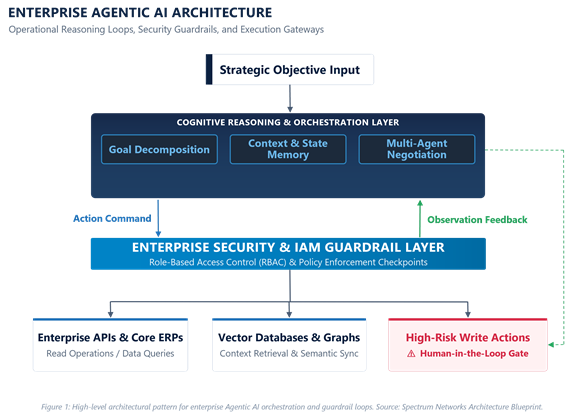
A. Reasoning and Execution Loops
At the heart of an agent is its cognitive architecture. Unlike basic LLM calls, agents utilize structured loop frameworks—such as ReAct (Reason + Act) or Plan-and-Solve methodologies.
The Architecture: The model takes an input, generates a thought (reasoning), decides on an action (calling an enterprise tool), observes the result, and loops back to update its strategy until the objective is reached. Architects must implement state management systems to track long-running agent workflows across multiple systems without losing context or memory.
B. Secure Tool Integration and Access Control
Because agents interact directly with your enterprise software stack, they cannot be given unrestricted access.
The Architecture: Agents must be governed by the exact same Identity and Access Management (IAM) policies and Role-Based Access Control (RBAC) that apply to human employees. A "Financial Auditing Agent" should interact with enterprise ledgers through isolated API gateways that strictly log, rate-limit, and audit every programmatic request.
C. The "Human-in-the-Loop" (HITL) Guardrail Layer
Total autonomy without governance is an immense operational risk. Architects must design multi-tiered execution boundaries.
The Architecture: While an agent can freely execute read-only actions (like compiling reports), high-risk write actions (like executing a financial wire transfer or deploying code to production) must hit an architectural checkpoint gate that halts the process until a verified human operator explicitly reviews and signs off on the agent's proposed action.
4. Conclusion: Navigating the Autonomous Frontier
Agentic AI marks a massive evolution in enterprise capabilities, taking organizations beyond simple text generation into a world of automated execution and complex orchestration. However, deploying these highly autonomous, tool-enabled agent ecosystems requires a steep step up in architectural governance, advanced data engineering, and strict security compliance.
As enterprise infrastructure adapts to manage these automated systems, the defining differentiator for successful organizations will be the technical preparedness of their engineering, cloud, and security teams.
Scale Your AI Execution Strategy: Partner with Spectrum Networks
Transitioning from basic conversational models to secure, scalable Agentic AI infrastructure requires specialized skills in cloud management, cognitive design patterns, and comprehensive guardrail engineering. As enterprise landscapes shift toward automation, Spectrum Networks provides the official, vendor-authorized training pathways to ensure your workforce is equipped to architect, secure, and lead these next-generation ecosystems:
Microsoft 365 Copilot & Azure AI: Move beyond standard prompting. Learn to extend Microsoft Copilot with Custom Agents, design secure orchestrations, and connect workflows natively to your enterprise data layers through our Microsoft Azure Certification Training.
AWS Bedrock & Agent Frameworks: Master the design of fully autonomous agents using Amazon Bedrock, integrate secure API actions, and manage isolated multi-agent environments via our AWS Certification Training.
Google Cloud Vertex AI & Vertex Agents: Learn to leverage Google’s advanced Gemini models alongside Vertex AI Agent Builder to create powerful, grounded, and secure digital workforces aligned with enterprise RBAC through our Google Cloud Platform (GCP) Certification Training.
Don't just assist your business operations—automate them securely. Contact our corporate training consultants today to architect your specialized AI skilling roadmap.
For more details reach out to us at info@specnt.com