


Sovereign Cloud Architecture: Navigating the New Era of Data Residency
The fundamental premise of the early public cloud was borderless, seamless data processing across globally distributed infrastructure. However, as digital economies matured, this model collided directly with shifting technological regulatory landscapes and geopolitical fragmentation. Nations and regulatory bodies now view data not just as a corporate asset, but as a critical element of national security and digital sovereignty.
For modern businesses, public sector organizations, and global technology consulting partners, this paradigm shift has given rise to a mandatory architectural framework: Sovereign Cloud Architecture for Data Residency.
1. Defining the Sovereign Cloud in the Modern Enterprise
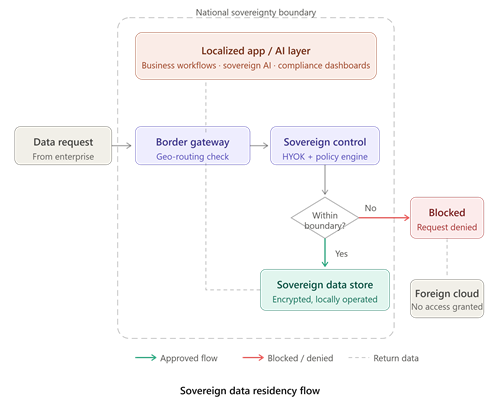
At its core, a Sovereign Cloud is an infrastructure environment designed to ensure that all data, metadata, and operational workflows remain under the absolute legal, geographic, and administrative jurisdiction of the host nation. It shifts the corporate conversation from generic data protection to absolute digital self-determination.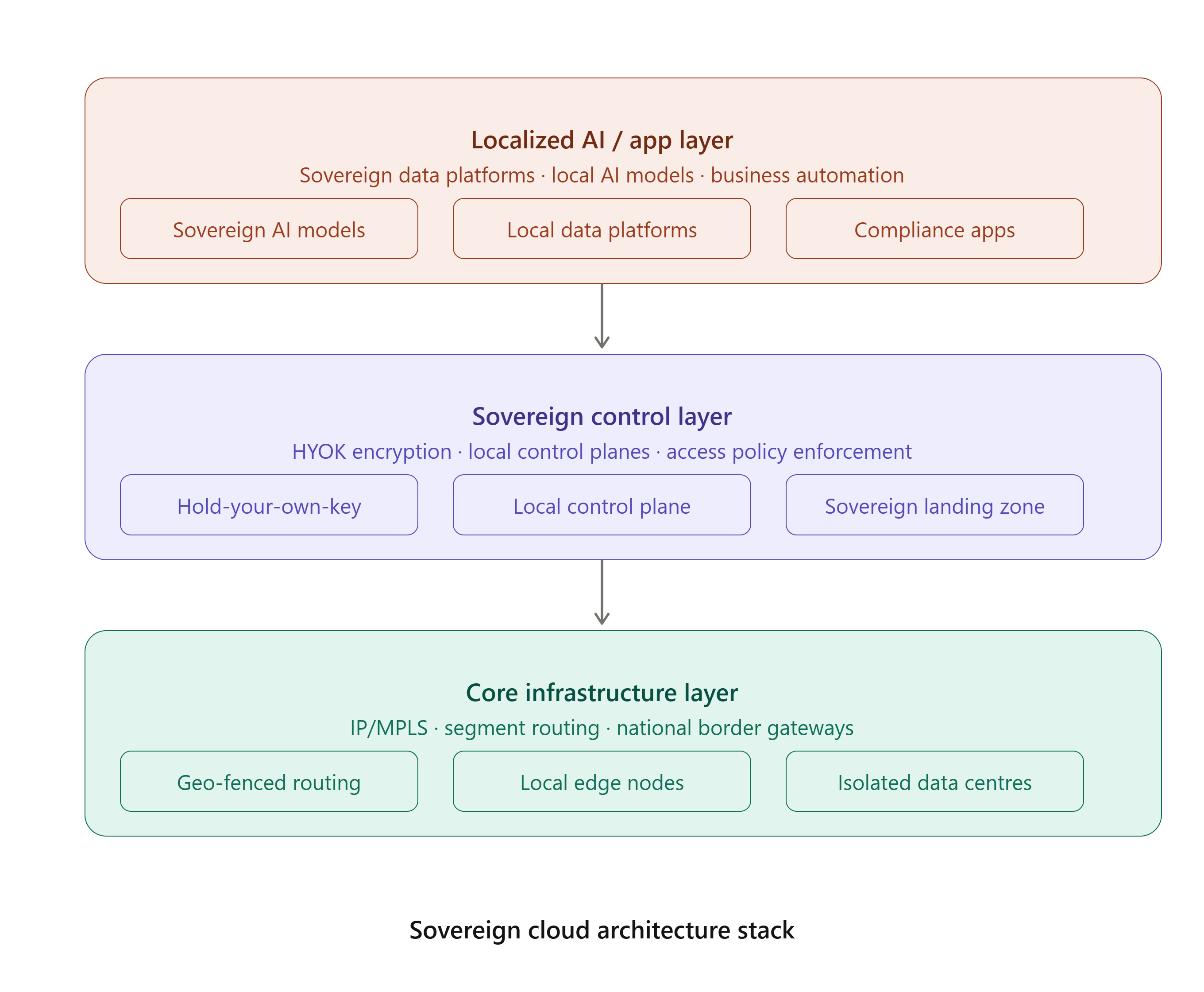
For enterprises deploying a sovereign cloud architecture, the strategic implications are clear:
- Absolute Legal Protections: It guarantees that organizational data is completely shielded from foreign legal overreach, extraterritorial subpoenas, or foreign intelligence intercept laws (such as the US CLOUD Act).
- Operational Continuity: It protects against geopolitical turbulence, ensuring that if international borders close or diplomatic relations sour, critical cloud infrastructure and national data stores cannot be remotely disabled, wiped, or modified by external actors.
- Regulatory Alignment: It provides an architectural mechanism to comply with stringent local data protection mandates, avoiding catastrophic regulatory fines, reputational damage, and sudden operational shutdowns.
2. Architectural Enforcement: How Hyperscalers are Adapting
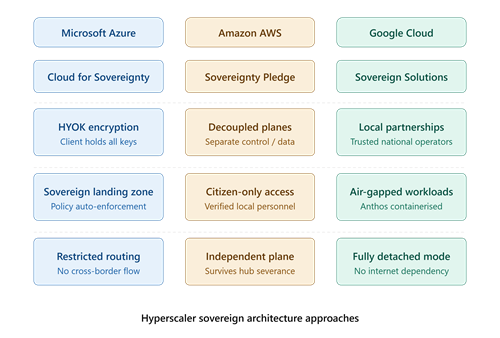
Sovereignty cannot simply be achieved by signing a legal compliance contract; it must be enforced explicitly at the infrastructure, software, and encryption layers. Leading global hyperscalers—historically criticized for highly centralized architectures—have fundamentally redesigned their cloud paradigms to provide dedicated sovereign frameworks.
Strategic industry insights published by analysts at IDC and Gartner indicate that the market has decisively shifted from a one-size-fits-all public cloud to a multi-cloud, distributed architecture designed explicitly to manage data localization constraints. Furthermore, architectural frameworks compiled by research institutes like EconStor emphasize that sovereignty must be embedded natively within the infrastructure, software, and encryption layers to be truly effective.
Microsoft Azure: Cloud for Sovereignty
Microsoft’s architectural response focuses heavily on providing Sovereign Controls and Guardrails natively embedded within its public Azure footprint.
- Key Mechanisms: They employ a "Hold Your Own Key" (HYOK) paradigm, giving local clients absolute custody of encryption keys completely isolated from the global cloud plane.
- Operational Boundary: They utilize highly restricted Sovereign Landing Zones that enforce automated policy configurations, preventing data from being routed outside strict national parameters.
Amazon Web Services (AWS): The Digital Sovereignty Pledge
AWS designed its sovereign strategy around decoupling data residency from global operational management planes.
- Key Mechanisms: Through its dedicated AWS European Sovereign Cloud and sovereign-by-design architectures, AWS restricts server access and support exclusively to verified local citizens residing within the specific jurisdiction.
- Control Plane Isolation: They provide independent control planes that allow local operational continuity even if connections to global parent data hubs are entirely severed.
Google Cloud: Sovereign Solutions & Distributed Footprints
Google’s approach heavily leverages strategic joint ventures and distributed architectures.
- Key Mechanisms: Instead of merely building regional data centers, Google collaborates directly with local trusted partners—such as national telecoms or government-backed entities—to operate their infrastructure under local corporate umbrellas.
- Technological Layer: They use open-source-aligned, containerized platforms to enable organizations to deploy hybrid, air-gapped workloads that function completely detached from the global internet.
3. Global Regional Trends in Digital Sovereignty
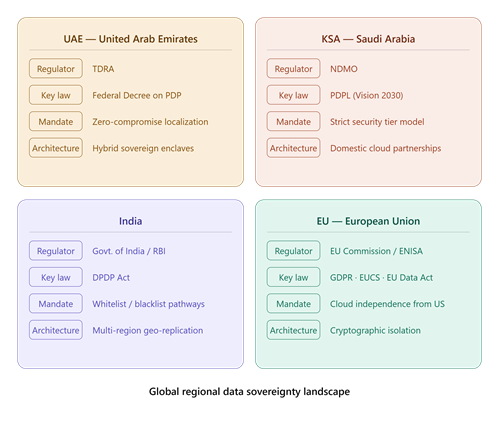
The execution of sovereign cloud architecture varies drastically based on geography, driven by distinct regional legislation and market dynamics. True compliance requires a multi-layered approach:
The United Arab Emirates (UAE)
The UAE has aggressively established itself as a global technology and artificial intelligence capital, backed by robust data protection laws.
- The Framework: Governed by the Telecommunications and Digital Government Regulatory Authority (TDRA) and the UAE Federal Decree-Law on Personal Data Protection, the nation enforces zero-compromise localization for government records, healthcare informatics, and critical national infrastructure data.
- Architectural Reality: This has driven major hyperscalers to open dedicated, isolated cloud regions in Abu Dhabi and Dubai. Enterprises operate on a hybrid-by-design model, anchoring sensitive metadata on-premises or within specialized sovereign enclaves while leveraging hyper-local public cloud nodes for non-sensitive data pipelines.
The Kingdom of Saudi Arabia (KSA)
As a core pillar of its Vision 2030 digital transformation, Saudi Arabia enforces some of the strictest data residency mandates across the Middle East.
- The Framework: The National Data Management Office (NDMO) and the Personal Data Protection Law (PDPL) segregate data into strict security tiers. Any data vital to public safety, national security, or state wealth is legally barred from crossing geographical boundaries.
- Architectural Reality: Cloud providers cannot operate globally centralized nodes inside the Kingdom; they must build isolated local clouds managed through domestic corporate partnerships, utilizing locally restricted hypervisors and custom local data platform nodes.
India & the APAC Region
In APAC, rapid sovereign adoption is heavily driven by massive digital citizen scale and data localization policies.
- The Framework: In India, the Digital Personal Data Protection (DPDP) Act grants the government overarching authority to regulate cross-border data pathways. Concurrently, the Reserve Bank of India (RBI) mandates total domestic localization for all financial transaction data.
- Architectural Reality: The architectural response requires population-scale data engineering platforms. Enterprises must rely on multi-region geo-replication entirely contained within national borders, utilizing localized edge networking to fulfill low-latency constraints without routing traffic through international border gateways.
The European Union
Europe remains a global ideological standard for data privacy, heavily shaping the very definition of digital sovereignty.
- The Framework: Moving beyond basic GDPR compliance, the EU's modern focus targets absolute cloud independence through the European Cloud Services scheme (EUCS) and the EU Data Act. The core objective is reducing reliance on non-European tech conglomerates.
- Architectural Reality: European organizations actively mandate local data immunity. This requires strict cryptographic isolation, the adoption of regional container platforms (such as Red Hat OpenShift), and a growing reliance on local European cloud operators to manage highly sensitive public and financial workloads.
4. Conclusion: The Full-Spectrum Mandate
Sovereign cloud architecture proves that modern digital transformation can no longer treat infrastructure and applications as separate silos. To achieve true compliance and operational stability, organizations must engineer sovereignty across the full technology spectrum: from core routing networks that keep data inside geographic boundaries, up through encrypted cloud storage planes, all the way to localized business automation and sovereign AI platforms.
Building, managing, and upskilling teams to operate within these highly specialized, restricted environments is the next major milestone for enterprise IT leaders.
Navigating Sovereign Architectures: Empower Your Teams
Implementing a robust sovereign cloud architecture requires deep technical expertise and an intimate understanding of modern landing zones, cryptographic boundaries, and policy guardrails. As an authorized training partner for the world’s leading cloud platforms, Spectrum Networks helps enterprises design, deploy, and manage legally compliant, secure architectures.
Equip your IT and engineering teams with the official skills needed to navigate these complex regulatory environments through our specialized vendor training tracks:
- Microsoft Cloud for Sovereignty: Master sovereign landing zones, policy configurations, and advanced encryption controls with our Microsoft Azure Certification Training.
- AWS European Sovereign Cloud: Learn control plane isolation, data residency strategies, and restricted local management workflows through our AWS Certification Training.
- Google Cloud Sovereign Solutions: Build open-source-aligned, containerized, and hybrid architectures with our Google Cloud Platform (GCP) Certification Training.
Ensure your digital transformation strategies are backed by certified expertise. Contact us at info@specnt.com to build your custom corporate skilling track.
📑 Industry Sources & References
- IDC Whitepaper Reports: Worldwide IT Industry Predictions (Article ID: US50795823).
- EconStor Open Academic Publications: From concept to method: A framework for measuring digital sovereignty, M. P. Rodríguez Pita.
- Veredas do Direito: Data residency-aware multi-cloud strategy: Designing hybrid and multi-cloud architectures under localization and regulatory constraints, M. M. U. Hasan.
- University of Turku Research: Reducing Cloud Dependency: Architectural Strategies and the Role of European Cloud Providers, J. Heikkilä.
- Journal of Globalizations: A green transition orchestrated from Big Tech clouds?, C. Rikap.